Humanistic Heathenry embraces the rituals, stories, and cosmology of the Heathen tradition as powerful sources of meaning—without requiring belief in literal gods or the supernatural. We see the myths as symbolic maps of the human journey, and our blóts, sumbels, and seasonal rites as ways to connect with community, honor heritage, and live in harmony with the natural world. Even without theism, Heathenry offers enduring values of reciprocity, honor, and interconnectedness—wisdom the modern world still needs.
On this site you will find ideas for integrating Heathenry and Atheopaganism, including holidays, rituals, and various celebrations, as well as recommended resources for pagan practices, historical literacy, and scientific appreciation. We do not claim to be an authority on any given topic; we are merely fellow travelers on intersecting paths.
For more information about what we are striving for, please see our “FAQ” page.
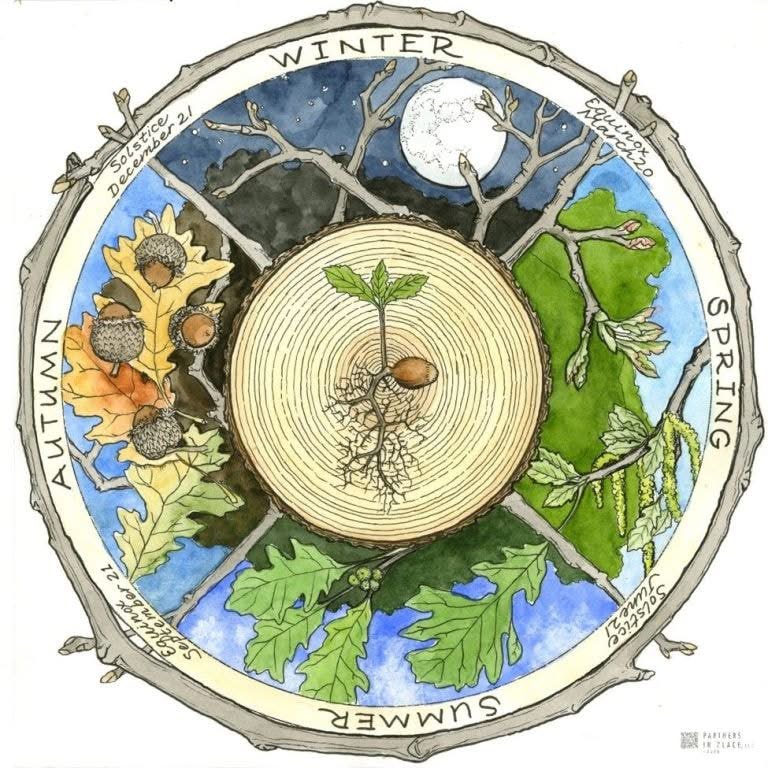
The Way of Ash and Elm is an eclectic approach that uses a modified version of the Wheel of the Year, one that specifically mixes elements of Atheopaganism and Humanistic Heathenry (as the holiday names will attest). The rationale for observing the Wheel of the Year is two-fold:
Marks the actual, physical changes in the seasons — observing shifts in light, temperature, plant and animal life, and human activity.
Serves as a symbolic cycle of life — with each point representing a stage from conception to death (and renewal), while keeping the imagery grounded in metaphor rather than supernatural belief.
Furthermore, The Way of Ash and Elm frames the Wheel of the Year so that one half focuses on the darker forces of life and the other half on the lighter forces, without framing either as “good” or “bad,” but as equally essential parts of a natural, human, and mythically symbolic cycle. As we are located in New England, our approach reflects the seasonal changes that occur in our area. Those living in a different ecology or in the Southern Hemisphere will understandably want to adjust the wheel for their own seasonal experiences.
Themes: Decline, loss, fear, introspection, rest, and transformation.
This is not about “evil” or “bad” forces — it’s about the natural processes of decay, uncertainty, and stillness that make renewal possible.
In a Humanist Heathen view, these forces are part of the wyrd (interconnection) of life — they shape us as much as joy or growth.
Seasonal progression:
Winter Finding / Autumn Equinox – Acknowledgement of balance shifting toward darkness. Recognize life slowing and the harvest ending.
Winter Nights / Alfablót – Death and remembrance. Confront mortality directly, honor the dead, and release what has run its course.
Yule / Winter Solstice – Deep stillness. The darkness is longest here — yet it carries the spark of renewal. Reflect, dream, and plant the seeds of intention in quiet.
Brightening / Dísablót – Preparation for return. First signs of light and growth appear; we start to ready ourselves for the work ahead.
Psychological work in the dark half:
Facing fears: Acknowledge anxieties and uncertainties rather than denying them.
Letting go: Practice releasing habits, relationships, or roles that no longer serve you.
Resting deeply: Understand that stillness is productive; it’s the composting phase of the soul.
Drawing inward: Use quiet seasons for reflection, journaling, and deeper emotional processing.
The Light Half
— Summer Finding / Spring Equinox → Dimming
Themes: Growth, vitality, joy, creation, and outward engagement.
Here, energy rises, life expands, and possibilities open.
In Humanist Heathenism, these are times to act in the world — plant, build, teach, celebrate, and connect.
Seasonal progression:
Summer Finding / Spring Equinox – Balance returning toward light. Welcome visible renewal and set plans in motion.
Sigurblót – Vitality and joy. Celebrate love, beauty, and the playful side of life.
Midsummer / Summer Solstice – Full strength. Recognize your own power and take bold steps toward your goals.
Dimming – Responsibility and gratitude. Share abundance, honor your work, and prepare for the coming shift back toward darkness.
Psychological work in the light half:
Taking action: Build, grow, and create in the physical world.
Connection: Strengthen bonds with community and the land.
Celebration: Make space for joy and play as essential parts of life.
Generosity: Share what you have learned and cultivated with others.
Why This Matters for a Humanist Heathen:
No moral dualism: Dark and light are not “good vs. evil,” but complementary forces in nature and human life.
Natural grounding: The cycle mirrors observable seasonal change, giving you an anchor in the real world.
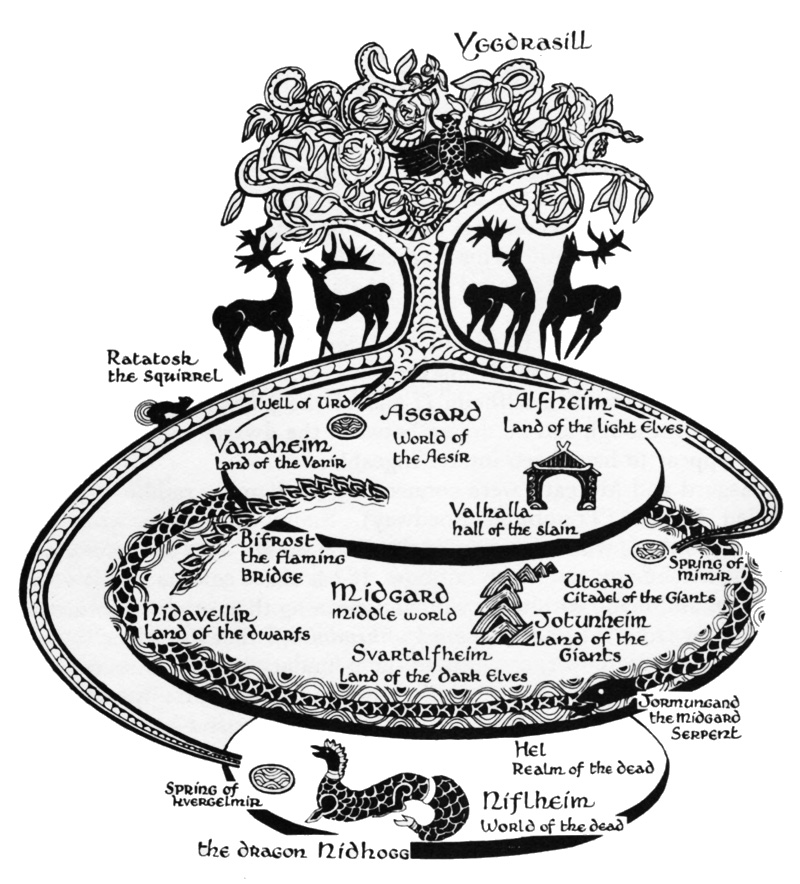
Mythic metaphor: Norse imagery can embody these forces — Helheim and Niflheim for the dark half; Vanaheim and Álfheim for the light half — without assuming supernatural beings are real.
Self-awareness: Following this pattern helps you see where you are emotionally and physically in the year’s ebb and flow, and adjust accordingly.
Our Approach
Found below is The Way of Ash and Elm’s version of the Humanist Heathen Wheel of the Year. It is an approach that merges:
Seasonal change (nature’s cycle)
Life stages (conception → death)
Nine Worlds meditations (symbolic Norse cosmology)
Dark and light forces as natural, necessary complements
Why This Works for a Humanist Heathen:
Nature as sacred: The focus is on the tangible: the turning of the earth, the seasons, and our relationship to them.
Myth as metaphor: Norse or other mythic imagery can be layered onto each stage, but not taken literally.
Life cycle reminder: Moving through the year mirrors our own lives, helping us reflect on where we are and what’s next.
Grounded awe: You can feel reverence without requiring the supernatural — the cycle itself is enough.
Wheel of the Year
1. Yule / Winter Solstice – Conception
Nature: The longest night, when the sun begins its return. Stillness, rest, and the promise of light.
Life stage: Conception — a hidden spark of potential. The seed of life exists but has not yet emerged, like conception in the womb or the spark of a new idea.
Nine Worlds meditation: Niflheimr — Rest and stillness, holding the seed of what will come.
Dark half focus: Finding hope in the depths of darkness.
Practice: Gather in warmth and community, light candles, and reflect on intentions for the year ahead.
2. Brightening / Dísablót – Gestation
Nature: Early signs of change — days lengthen, first shoots appear, animals prepare for birthing.
Life stage: Gestation — development beneath the surface, unseen but vital.
Nine Worlds meditation: Muspelheimr — Warming the spark into readiness for action.
Dark half focus: Quiet preparation before action.
Practice: Honor female ancestors and fertility; begin projects quietly; clear space for growth; honor patience and preparation.
3. Summer Finding / Spring Equinox – Birth
Nature: Day and night balanced; plants emerge; migrations begin.
Life stage: Birth — emergence into the world.
Nine Worlds meditation: Vanaheimr — Nurturing growth and harmonizing with life’s rhythms.
Light half focus: Taking first steps into the new season.
Practice: Spend time outdoors noticing new life; celebrate fresh starts and the courage to “arrive” in the world; celebration children.
4. Sigurblót / May Day – Youth
Nature: Blossoming, mating season, vibrant colors, and abundance of energy.
Life stage: Youth — playfulness, curiosity, and exploration.
Nine Worlds meditation: Álfheimr — Wonder, beauty, and creativity.
Light half focus: Celebration and play as life force.
Practice: Actively work for a better world; celebrate joy through dance, music, and feasting; create art, and revel in physicality and joy.
5. Midsummer / Summer Solstice – Adulthood
Nature: Longest day, plants at full strength, warmth at its height.
Life stage: Adulthood — maturity, peak vitality, and creative power.
Nine Worlds meditation: Ásgarðr — Clarifying purpose and committing to high goals.
Light half focus: Committing to your highest goals.
Practice: Recommit to personal goals, celebrate achievements, and share your energy with others.
Nature: First crops are gathered; work is steady and intentional.
Life stage: Responsibility — providing for others, creating security, tending what you’ve built.
Nine Worlds meditation: Svartálfaheimr — Craft, creation, and skill.
Light half focus: Sharing abundance, teaching, and building resilience.
Practice: Bake bread, share food, make or repair something important; share skills, teach, give back to your community, and appreciate what you have built.
7. Winter Finding / Autumn Equinox – Elderhood
Nature: Day and night balanced again, but darkness begins to grow; harvest nearing completion; leaves turn.
Life stage: Elderhood — wisdom, reflection, mentorship, and a slower pace.
Nine Worlds meditation: Midgarðr — Grounding in everyday life and human connection.
Dark half focus: Acknowledging change, preparing for decline.
Practice: Share stories, mentor others, preserve knowledge, give thanks for what you have, enjoy the fruits of earlier work, and live deliberately.
8. Winter Nights / Alfablót – Death
Nature: The harvest is complete; fields are bare; dark deepens.
Life stage: Death, endings, and transformation — release, remembrance, and transformation.
Nine Worlds meditation: Helheimr — Memory and acceptance.
Dark half focus: Facing mortality and loss without fear.
Practice: Remember and honor those who have died; release what no longer serves you; reflect on the impermanence of all things.
Floating Meditation — Jötunheimr (Challenge)
Use: For challenges at any time of year. Use whenever you need courage and adaptability, regardless of the season.
Nature: Storms, sudden frosts, or any personal difficulty that arises during the year.
Life stage: Trials — meeting challenges with resilience.
Nine Worlds meditation: Jötunheimr — Facing obstacles and learning from them.
Why it’s floating: Hardship doesn’t obey seasonal boundaries; it can teach lessons in both halves of the year.
The following structured daily dedication practice was inspired by Gothi Bodvarr’s video at Northwoods Kindred. We thought it was a wonderful way to stay inspired by Norse mythology and have adapted it only slightly for The Way of Ash and Elm. Each day connects with its divine namesake and focuses on symbolic actions. The actions need not be elaborate—they are simple ways to stay connected to one’s practice and to remain mindful of oneself and of others.
Sol-Day (Sunday) – Joy & Vitality
Sólardag
Theme: Fueling the spirit and welcoming light.
Go outside and feel the sun on your skin.
Do something that brings happiness—play, art, music, laughter.
Reflect on one thing that sparked joy during the past week.
Máni-Day (Monday) – Reflection & Shadow Work
Mánadag
Theme: Introspection and emotional balance.
Spend time in meditation or quiet breathing.
Journal about fears, doubts, or unspoken thoughts.
Explore how your inner “shadows” can teach you self-compassion.
Týr-Day (Tuesday) – Service & Integrity
Týsdagr
Theme: Duty, honesty, and selflessness.
Do something that helps another person.
Practice honesty in speech and action.
Reflect: When have I set aside my own needs for the greater good?
Óðinn-Day (Wednesday) – Wisdom & Curiosity
Óðinsdagr
Theme: Learning and questioning.
Read something that expands your perspective.
Research a topic that fascinates you.
Ask yourself: What assumptions do I need to challenge?
Þórr-Day (Thursday) – Strength & Endurance
Þórsdagr
Theme: Physical well-being and resilience.
Engage in physical activity: exercise, hiking, or skill-building.
Do labor that grounds you in the physical world.
Reflect: How can I better protect and sustain my body?
Freyja/Frigg-Day (Friday) – Love & Kinship
Frjádagr
Theme: Connection with family, ancestors, and peace.
Spend time with loved ones (family or chosen family).
Share a meal or story.
Honor ancestors by remembering their lives or values.
Intentionally minimize conflict and cultivate harmony in the home.
Bathing-Day (Saturday) – Renewal & Maintenance
Laugardagr
Theme: Preparing the self and home for the cycle ahead.
Complete chores and responsibilities.
Clean your living space, bathe, and refresh your body.
Reflect: What do I need to clear away so the coming week flows smoothly?
In the Norse worldview, Yggdrasil, the great World Tree, connects Nine Worlds. In a Humanistic Heathen context, these realms are not literal places, but poetic lenses through which we can view aspects of our world, our lives, and our relationships. A libation to the Nine Worlds becomes a ritual of gratitude and reciprocity, honoring the interconnectedness of all things.
This ritual was inspired by the Atheopagan libation ritual which is practiced every thirteenth day of every month (thirteen being an important number in Atheopaganism). It was designed to be simple, easily accomplished, and to cross cultural boundaries. We thought that the Way of Ash and Elm could also put to good use a libation ritual, albeit one a bit more lengthy. We felt that since nine was an important number in Norse mythology, the ritual could be done on the ninth of every month.
Below is just one suggested version ﹘ as always, feel free to shorten, change, or just improvise your own version. In the spirit of the Atheopagan libation ritual, don’t worry about everything being perfect. This is a ritual that will hopefully require little effort and take only a few minutes.
Monthly Ritual: Libation to the Nine Worlds
You’ll need:
A drink of your choice (mead, cider, herbal tea, water, etc.) in a horn, cup, or jug.
A place outdoors where you can pour safely onto soil or into water.
Stand or sit in a mindful posture, and for each world:
Speak its name.
Reflect on its symbolic meaning in the human and natural world.
Pour a small portion of the libation to the earth.
1. Midgard – The Human World
The realm of humanity, community, and the shared challenges of life.
“To Midgard, our home. For the bonds we share, the homes we build, the work of human hands, and the kindnesses that make life worth living.”
2. Asgard – The Realm of Ideals and Governance
The seat of the Æsir: here seen as symbols of law, leadership, and higher aspirations.
“To Asgard, the realm of vision and order. For our shared values, our hopes for justice, and the wisdom to lead with honor.”
3. Vanaheim – The Realm of Growth and Abundance
Home of the Vanir: symbols of fertility, harmony with nature, and sustainable living.
“To Vanaheim, the green realm. For the soil that nourishes us, the harvests that sustain us, and the beauty of the living earth.”
4. Jötunheim – The Realm of Wild Forces
Land of the Jötnar, representing untamed nature, challenge, and transformation.
“To Jötunheim, the wild realm. For the storms that test us, the mountains that humble us, and the untamed power that shapes the world.”
5. Alfheim – The Realm of Inspiration and Beauty
Home of the Light Elves, symbols of creativity, artistry, and joy.
“To Alfheim, the bright realm. For music and art, for laughter and play, and for the spark of creativity in all hearts.”
6. Svartalfheim – The Realm of Craft and Ingenuity
Home of the Dwarves: masters of skill, creation, and resilience.
“To Svartalfheim, the deep realm. For the makers, the builders, and the clever hands that shape the tools of our lives.”
7. Niflheim – The Realm of Ice and Memory
Land of cold mists, representing the past, reflection, and the stillness before change.
“To Niflheim, the realm of memory. For the lessons of the past, the ancestors who shaped us, and the quiet moments that teach us.”
8. Muspelheim – The Realm of Fire and Passion
Home of primal flame, symbolizing transformation, drive, and creation through destruction.
“To Muspelheim, the fiery realm. For the warmth that sustains life, the passion that fuels us, and the courage to embrace change.”
9. Helheim – The Realm of Rest and Release
The land of the dead, representing endings, acceptance, and the cycles of life.
“To Helheim, the realm of rest. For the peace that follows labor, the return of all things to the earth, and the memory of those we love.”
Closing
When the final portion is poured, say:
“The Nine Worlds are honored, the libation is poured, and the circle of giving is complete. May what we have shared return to us in new forms, and may we walk our days mindful of the web that binds us all.”
A sumbel is a ritual drinking ceremony in which participants speak in turn while passing a cup, horn, or other vessel. In traditional Heathenry, it often includes toasts to gods, ancestors, and heroes, along with oaths, boasts, and recitations. A Humanistic Heathen sumbel adapts this practice for those who see the gods as symbols and stories rather than supernatural beings, focusing instead on shared values, community bonds, and the human experience.
How It Differs from a Traditional Heathen Sumbel
Symbolic rather than literal theology: A traditional Heathen sumbel may include toasts to gods as literal beings; in a humanistic heathen sumbel, these toasts are understood symbolically, as evoking ideals, virtues, or cultural stories.
Inclusivity in focus: Rather than assuming shared belief in the supernatural, this version is built to welcome atheists, agnostics, and theists alike, as long as they honor the ritual’s spirit of respect and sincerity.
Broader interpretation of oaths: While traditional oaths may be sworn before gods and ancestors, in this version they are commitments made to oneself and to the community’s shared memory.
Emphasis on human connection: The central purpose is strengthening human bonds, fostering gratitude for the past, solidarity in the present, and shared hope for the future.
Nevertheless, in The Way of Ash and Elm we retain some traditional aspects of the sumbel that we feel help to keep alive the sacred spirit of the ritual. Firstly, our drink of choice is still mead. Secondly, after each round we pour a bit of the mead into a ritual bowl. The bowl symbolizes our group’s luck and bond, and when the ritual is over we offer its contents to the land by pouring it onto the earth, symbolically honoring the local landvættir.
In our Winter Finding celebration of 2024 we held a large sumbel that included mostly college educated atheists, including trained scientists. For most it was their first encounter with Heathenry, humanistic or otherwise. The unanimous feedback from all who participated was that the sumbel was a powerful shared experience for them, one they could not soon forget.
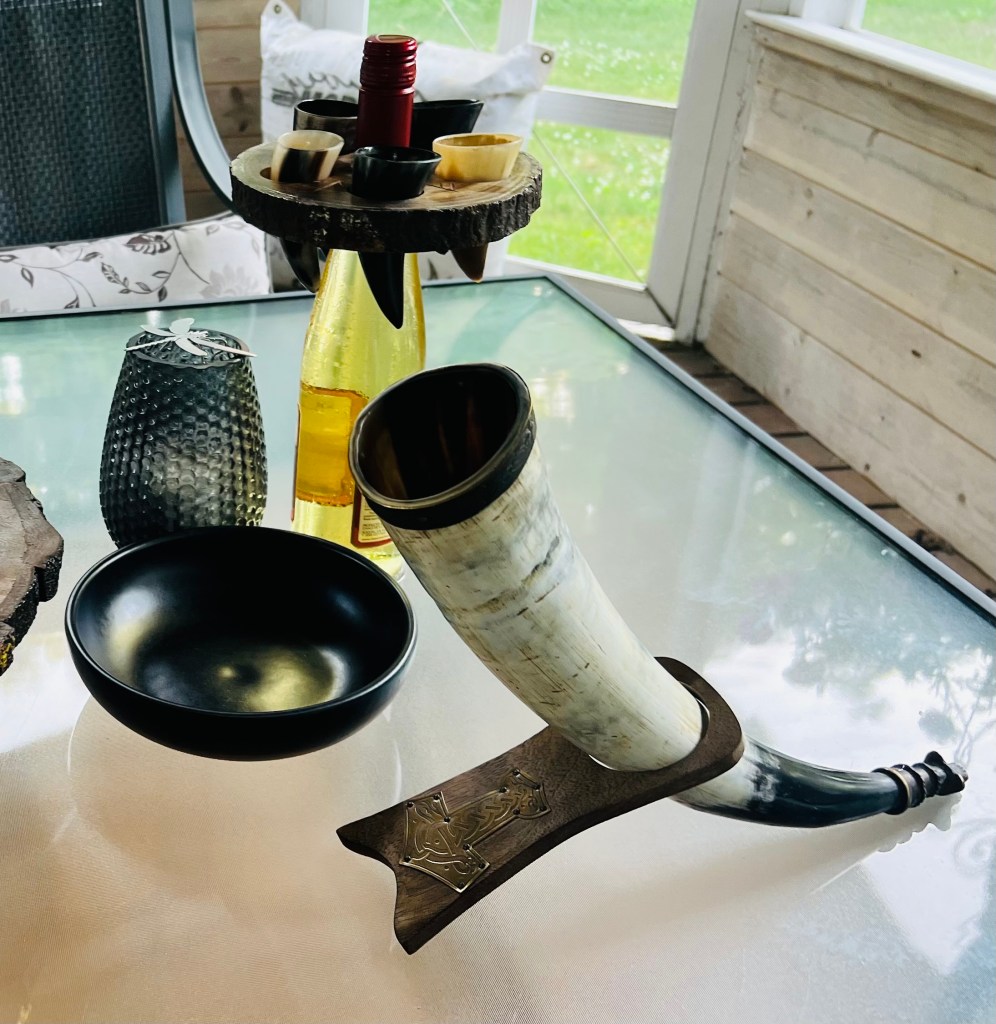
Horn, bowl, and mead ready for a Midsummer sumbel.
The Sumbel: Past, Present, and Future
In our version, the sumbel is divided into three rounds, each representing a different relationship with time:
Opening Words
Facilitator speaks:
“We gather together in the spirit of sumbel—an ancient custom of passing the cup and speaking from the heart.
In our way, we honor the threads of time that bind us: the past that shaped us, the present we share, and the future we will help to weave.
As the horn passes, each person will speak in turn. You may share a memory, a thought, a boast, or a promise. Speak with sincerity, for the words we share here will be remembered.”
(For a more mythical opening that honors Odin, see below)
First Round – The Past
The cup is passed in honor of those who came before: ancestors, historical figures, mentors, or cultural influences that shaped the community. People may share stories about loved ones who have died, read a meaningful poem, or reflect on moments from history that inspire them. The focus is on memory, gratitude, and recognizing the lessons of the past.
Facilitator:
“We begin with the past. As you take the cup, honor those who came before: ancestors, mentors, friends, and figures whose lives still inspire us.
Speak their names, tell their stories, and share the lessons they left behind.”
(Horn is passed around. Each participant shares. Drink is offered to the bowl.)
Second Round – The Present
This round honors those gathered in the here and now. Participants may toast to the group as a whole, praise one another’s accomplishments, or share personal victories and challenges. It’s also a chance for boasting in the best sense: acknowledging one’s own work, creativity, or acts of kindness without shame. The aim is to strengthen community ties through mutual recognition and encouragement.
Facilitator:
“Now we turn to the present. This round is for honoring those here today, and for recognizing the work and worth of ourselves and each other.
Share your victories, your gratitude, or the things you are proud of. We boast not to diminish others, but to lift one another up.”
(Horn is passed around. Each participant shares. Drink is offered to the bowl.)
Third Round – The Future
This is the round for looking ahead. Participants may speak of upcoming plans, goals, or commitments—both personal and communal. Oaths may be made, not to supernatural forces, but to one’s own integrity and the support of the community. These words carry weight; by speaking them aloud, participants invite others to witness and encourage their fulfillment.
Facilitator:
“Finally, we speak to the future. This is the time for sharing hopes, plans, and oaths. An oath in this hall is a promise to yourself and to this community.
Let your words carry weight, for they will live on in the memory of those who hear them.”
(Horn is passed around. Each participant shares. Drink is offered to the bowl.)
Closing Words
Facilitator:
“The cup has made its journey through the three realms of time: past, present, and future. May we remember the lessons of the past, act with honor in the present, and work toward a future worth toasting.
The sumbel is ended, but its spirit continues in how we live from this day forward.”
(The bowl’s contents are respectfully poured onto the earth.)
(Optional) A Mythical Opening: Odin’s Ravens
Facilitator:
“We perform this sumbel through Odin’s inspiration. Odin, Allfather of the Aesir. Odin, who shaped the earth with the corpse of Ymir. Odin, who gave his eye to the well of Mimir that he might drink from it and learn wisdom. Odin, who hung from Yggdrasil for nine windy nights, impaled by his own spear, sacrificed himself to himself, wailing in agony, so that he might learn the secrets of the runes. Odin, who seduced Gunnlöd for three nights so that he might steal the mead of poetry. Odin, lord of the Valkyries, host of Valholl, father to Thor, Baldr, Vithar and Vali. Odin, Shield Shaker, Evil Worker, Spearman, Lord of the Undead, Dweller in Frigg’s Embrace, Gallows’ Burden, Ancient One, Wanderer, Gore Master, Swift in Deceit, Maddener, Wise in Magical Spells, Goði of the Raven-Offering, God of the Hanged, Teacher, Hoary Beard, High One, Glad of War, Battle Wolf, Screamer, Wayfinder, One-Eyed, Raven God, Roarer, Yule Father, God of Runes, Finder of Truth, Victory Giver, Foe of the Wolf, Chooser of the Slain, Smith of Battle, Terrible One.
Each day Odin sends out his ravens, Huginn (“Thought”) and Muninn (“Memory”), to fly across the lands and then return at night to report back to him what they learned. In the Poetic Edda poem Grímnismál, Odin states:
Hugin and Munin fly each day
over the spacious earth.
I fear for Hugin, that he come not back,
yet more anxious am I for Munin.
The ravens can be seen to symbolize many things, but clearly Odin expresses an anxiety that intellect and, more so, knowledge of the past might be lost to him. Memory allows us to learn from the past and to give honor to those who came before, and thought allows us to understand the present and imagine the future. By using Odin as our inspiration, and his ravens as our guide, our sumbel will move through three stages, each involving the passing and drinking of the mead. The themes will be past, present, and future.”
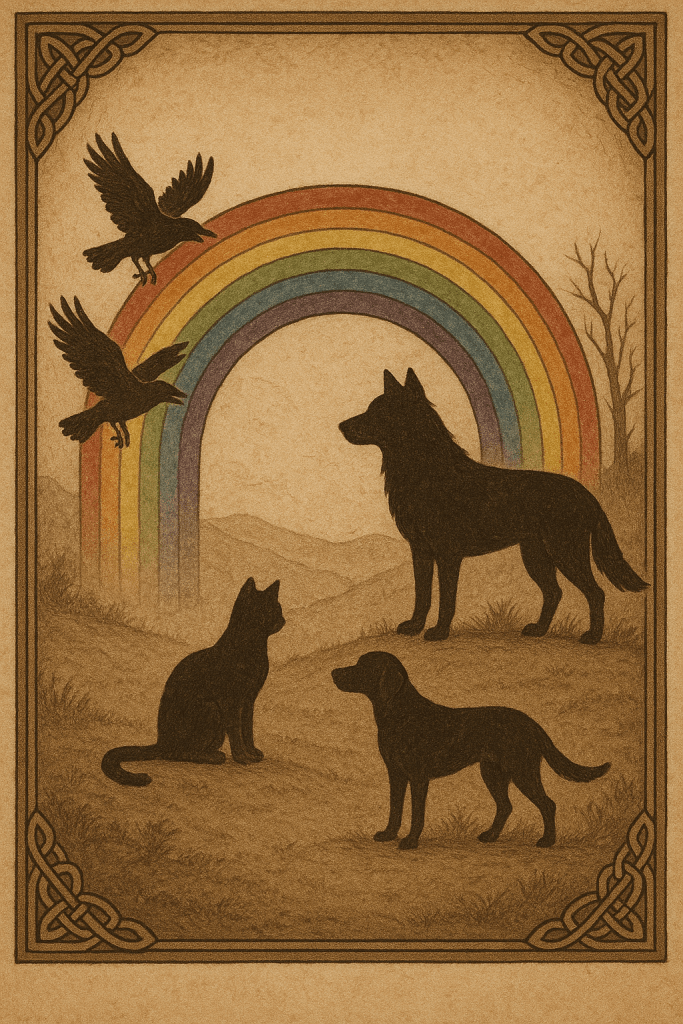
Bright arches span the sky,
woven of sunlit rain.
We walk them in our hearts,
where pawprints never fade.

Bifröst is the bridge we build
of laughter, love, and years—
each memory a shining plank,
each shimmer reflecting cheer.
Rainbow Bridge Remembrance Day is observed annually on August 28th to honor and remember beloved pets who have passed away. It’s a secular holiday for pet owners to reflect on the joy and love their animal companions brought into their lives and to celebrate their memories. The day is inspired by the “Rainbow Bridge” poem, which speaks of a place where pets wait to be reunited with their owners. It was created by author Deborah Barnes in 2015, in memory of her cat, Mr. Jazz, who passed away on August 28, 2013. She established the day to provide a way for people to honor and remember their beloved pets who have crossed the Rainbow Bridge. It’s a day for sharing stories, photos, and memories of pets that have passed away.
Here’s how people typically observe Rainbow Bridge Remembrance Day:
Sharing Memories:
Many pet owners share stories, photos, and fond memories of their pets on social media platforms.
Writing:
Some people write letters or journal entries to their departed pets, expressing their love and grief.
Creating Memorials:
Creating a memory garden or other personal memorial can provide a serene space to reflect on the pet’s life.
Reflecting and Connecting:
The day provides an opportunity to reflect on the profound bond shared with pets and to connect with others who have experienced similar losses.
Light a Candle:
Some people light a candle or visit a special place to remember their pet.
Ultimately, Rainbow Bridge Remembrance Day is a time to honor the pets who have touched our lives and to acknowledge the enduring love we have for them. That it comes with its own ritual tradition makes the holiday easy to adapt. A Humanistic Heathen twist could blend this with the Norse concept of Bifröst, the shimmering bridge between worlds. In this version:
Symbolic Frame: The bridge is a metaphor for memory. Your love and remembrance are what “connect” you to your animal friend across time and death.
Mythic Parallel: Just as Odin’s ravens return each day with news, our memories “fly back” to us, keeping our pets’ spirits alive in thought.
Role of Animal Companions in Myth: The gods’ animals are more than pets, they are partners, helpers, and extensions of their identities. Remembering our own animals can be framed as honoring the same deep bond.
The Norse myths are replete with animal companions, as the examples below show:
Odin –
Huginn (“Thought”) and Muninn (“Memory”), his two ravens who fly over the world and bring him news.
Geri and Freki, his two wolves who stay by his side in Valhalla.
Sleipnir, Odin’s eight-legged horse, fast enough to carry riders between worlds.
Freyja –
Two great cats (unnamed in surviving sources) who pull her chariot. Often imagined as large, sleek forest cats or lynxes.
Hildisvíni, her loyal boar (“Battle-Swine”), who may also be her human companion Ottar in disguise.
Frey –
Gullinbursti, a golden-bristled boar forged by the dwarves, who pulls his chariot and shines like the sun.
Thor –
Tanngrisnir and Tanngnjóstr, his two goats who pull his chariot and can be eaten and resurrected if their bones remain unbroken.
Hel –
Garmr, a massive hound who guards the gates of Hel. (Sometimes considered distinct from Fenrir; sometimes confused with him in later sources.)
In addition to the above observance examples, here are some more explicitly Humanistic Heathen ways to connect Rainbow Bridge Remembrance Day with the Norse idea of Bifröst, the rainbow bridge between worlds, while keeping it symbolic and non-theistic:
I. Bifröst Candle Ritual
If you have a symbolic focus/altar, place upon it items that remind you of your pet: a collar, a photo, etc. Optionally, place rainbow-colored stones, paper strips, or flowers there to help visualize Bifröst.
Light a candle (or rainbow-colored tea-lights). Imagine this as opening the way to Bifröst.
Speak the names of the pets you’re remembering, imagining Bifröst as a path of love and memory.
Picture yourself walking across Bifröst in your mind, meeting your pet in a place of peace and beauty.
Reflect on the joy they brought and how you carry their influence forward in your life.
II. Storytelling Sumbel
Hold a small symbolic sumbel (drinking ritual) with friends or family.
In the first round, share stories about your pet.
In the second, speak about how they shaped who you are.
In the third, make a vow to honor them through kindness to other living beings.
III. Acts of Care in Their Honor
Donate to an animal shelter, volunteer, or bring supplies. Frame it as sending “light across the bridge” — your action is the bridge that connects your pet’s memory to living animals in need.
This is a holiday to celebrate the first harvest of the season. While Lughnasadh (or Lammas) is Celtic in origin, it resonates well with Norse pagan values—harvest, sacrifice, community, and gratitude to land spirits, ancestors, and gods like Freyr, Sif, and the landvættir. We can adapt it into a Norse-style harvest festival with seasonal symbolism like the John Barleycorn effigy, which fits seamlessly with Norse ideas of sacrifice and rebirth. In addition, weaving together the Atheopagan concept of The Dimming (the slow waning of light after the solstice) with Norse pagan traditions for Lughnasadh can create a beautiful, symbolic harvest ritual that honors both the turning of the wheel and the old gods and spirits.
We prefer to use the Atheopagan name for this holiday. The celebration observed as “Freyfaxi” by some Heathens is not an ancient or traditional Heathen observance. The name “Freyfaxi” was given to this modern summer festival in the mid-1970s by Stephen McNallen of the Asatru Free Assembly (AFA) as an attempt to create a Heathen version of the Wiccan Wheel of the Year. Using the term risks giving undeserved legitimacy to, and may also implicitly support or legitimize, the AFA and Stephen McNallen, organizations that most in the Heathen community rightly find problematic.
Themes: Gratitude for the abundance of the land, sacrifice and renewal, community and celebration, and honoring the cyclical nature of life, death, and rebirth. It’s a time to appreciate the fruits of labor and prepare for the transition into autumn.
Correspondences
Life-Cycle: Middle Age
Deities: Freyr, Sif, Thor
Foods: Freshly baked bread, berries, roasted corn, and root vegetables
Drinks: Ales and beers, grain alcohol
Colors: Yellow, orange, brown, and green
I. Ritual: From Sun’s Peak to Shadow’s Edge
Frame your Dimming rite around this central idea:
“The sun that crowned the sky at Midsummer now wanes. The light begins to fade. The golden grain king, John Barleycorn, prepares to fall so that others may thrive. The world dims—but not in grief; in transformation.”
Opening
Hallow the space (e.g. with a hammer sign or sacred circle) and acknowledge the transition: “We stand between light and dark, harvest and hunger.”
Fire and Shadow: Candle Reversal Ritual
Gather three or more candles. Begin with all candles lit. Throughout the ritual, gradually snuff or dim them until only one flame remains, symbolizing the coming quiet and the preservation of inner fire.
Symbolically Honor the Deities and Spirits
Freyr (god of fertility and peace): Offer mead or ale, fresh fruits, or bread to honor his role in agricultural abundance.
Sif (golden-haired goddess of grain): Offer a bundle of wheat or create a small corn dolly in her honor.
Landvættir: Leave offerings of butter, berries, milk, or bread near a tree or stone as thanks to the local spirits.
Álfar (ancestor spirits): Leave a small portion of your meal or bread effigy on the ancestor focus or burial place.
Blót for The Dimming
Offer the Barleycorn bread, mead, herbs, or other first fruits to the fire or focus.
Speak thanks for what has grown and what has sustained your community and family.
Pour a libation of mead or ale onto the earth or fire.
Close with a toast: “To the Light that was! To the Harvest we hold! To the Dark that comes!”
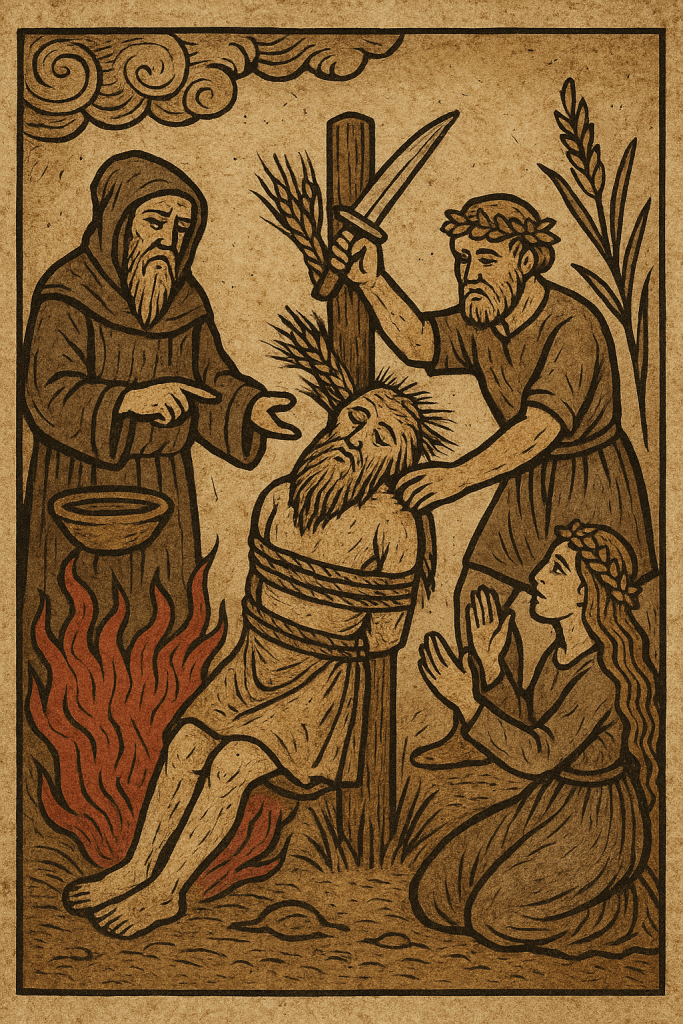
John Barleycorn must die.
II. Norse-Inspired John Barleycorn Ritual (Bread Effigy)
John Barleycorn—personification of the grain spirit—is an archetype that echoes Norse themes of death and renewal. Here’s a grim but entertaining way to integrate him:
Make a Barleycorn Bread Effigy
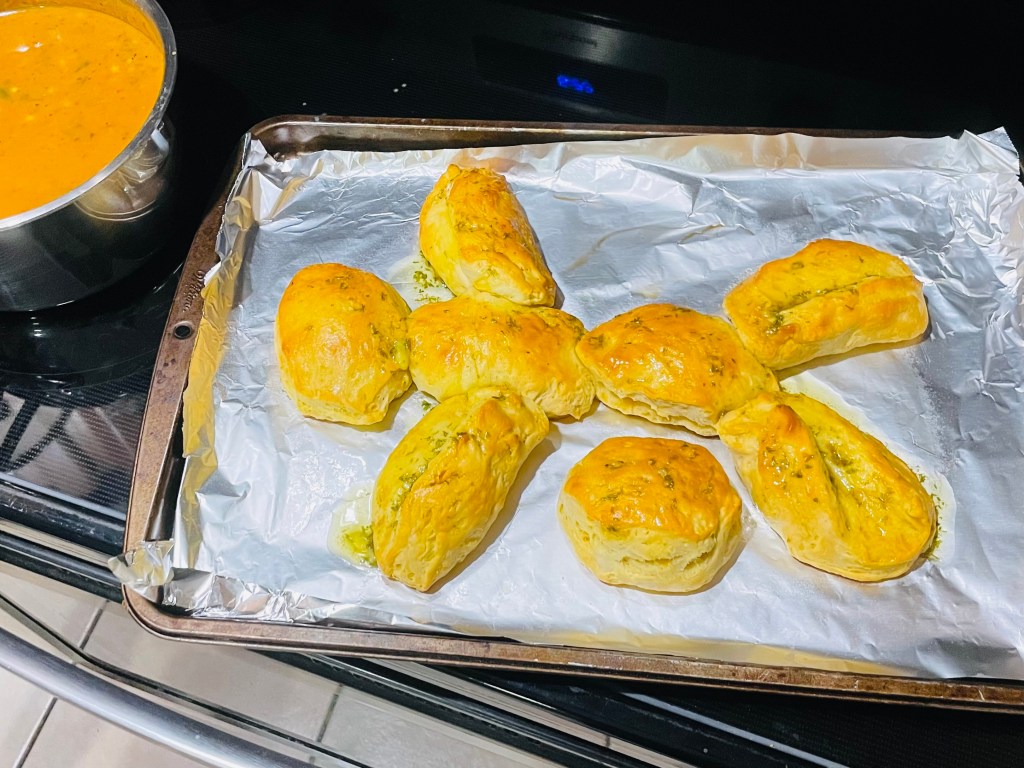
Bake a bread man (or woman) shaped like a crowned king (or even a sheaf or warrior). Decorate with seeds, grains, and herbs (like barley, wheat, thyme, rosemary, or even garlic).
Optionally give him a “sickle wound” as a symbol of the harvest cut or add a Jera rune (ᛃ) from the Old Norse word for “year” or “harvest,” signifying the completion of a cycle and the reaping of the fruits of one’s labor.
If you’re inexperienced at making bread dough, like me, Pillsbury biscuits with a garlic spread melted on top works just fine. (2025)
Offer Him in Ritual
Set the effigy on a focus with seasonal symbols (scythe, sheaf of grain, apples, mead).
Read or recite a tale or poem about the spirit of the grain dying to feed the people (you can adapt the John Barleycorn ballad or write a Norse-style kenning-laced version – see below).
Offer the Bread King to the Waning Light. Use the John Barleycorn bread effigy as a symbolic focal point.
Burn, bury, or ceremonially eat the effigy during the ritual, mirroring the cycle of death and nourishment.
Ritual action: At the height of the ritual, “sacrifice” the bread effigy—cut it or break it—naming this the turning point of the year.
Say something like:
“The barley dies, so we may live. The sun fades, so we may rest. May we find wisdom in the dark, and sustenance in the fading light.”
Eat or share the bread as a sacrament of transformation.
John Barleycorn: The Golden Sacrifice
(A Norse-Inspired Adaptation)

Three mighty men from Midgard’s fields
Went walking through the land,
With scythe and sickle in their hands
And purpose fierce and planned.
They swore an oath on stone and steel
To fell the Golden One—
To bind and break the barley-king,
The shining son of Sun.

They plowed the womb of Mother Earth,
Where Sif’s gold locks once lay,
And planted deep the seed of life
At dawn of sowing-day.
Freyr wept dew upon the field,
The elves gave root and care,
The land-wights danced in twilight hush—
A green-god sleeping there.

He rose with strength, a blade-bright boy,
A spear of stalk and grain,
With beard of wheat and sunlit crown,
He strode the summer plain.
The sickle came with whisper low,
A rune carved red with might—
They laid him down in field and flame,
And mourned him in the night.

They bound him up in earthen loaves,
They brewed him into cheer,
They sang to him in mead and malt
And drank him with the year.
His body fed the warrior’s feast,
His breath was in the ale—
Though slain, he rose in hearth and hall,
In song and harvest tale.

So hail to thee, O barley-lord,
Who falls and rises still,
Who sleeps beneath the plowed-black earth
And wakes upon the hill.
We honor you with loaf and horn,
With sacrifice and flame—
John Barleycorn, the golden king,
By many a hidden name.
III. Additional Activities
Arts and Crafts
Make Corn Dollies in the shapes of gods or spirits.
Weave wheat or oat straw into Norse knot designs or small runic charms.
Carve or decorate harvest runes (like Jera for harvest, Ingwaz for fertility) on wood slices or stones.
Recreation
Feast outdoors if possible, sharing foods from local harvests.
Storytelling or poetry: Share myths, kennings, or songs about growth, sacrifice, and the land.
Games or friendly contests in honor of early harvest festivals (akin to Icelandic glíma or strength challenges).
Shadow Walk: Take a walk at twilight after your ritual. Observe how the shadows lengthen, how plants go to seed, and how the world tilts toward rest.
Personal Growth
Personal Dimming: Reflect on what you are ready to let go of or allow to wane. Write it down and burn it as a release. Or bury a symbol of it near your garden or an ancestor tree
Charitable Action
Share the First Fruits – Freyr’s Generosity
Donate fresh produce from your garden or local farmer’s market to a food bank or community fridge, giving the “first fruits” in Freyr’s name.
Bake bread from scratch and give loaves to neighbors, elders, or those in need, symbolizing the sacredness of the grain harvest.
Offer Work and Skill to Others – The Labor of the Season
Help someone with physical tasks: yard work, moving, home repair. Offer it as a gift of labor, recognizing the spirit of the season’s toil.
Volunteer to teach a traditional skill (knitting, baking, foraging) at a community center or library, an act of both generosity and ancestral connection.
Sun-Gifts – Light and Warmth
Give practical “sun-blessings” like sunscreen, hats, or cold drinks to those working outdoors or experiencing homelessness.
Donate fans or air conditioners to shelters or families in need during the summer heat, honoring the sun’s strength.
Animal Offerings of Kindness
Make a donation to a farm animal sanctuary or help at one, honoring the animals who historically gave milk, wool, and meat during the harvest.
Provide pet food or supplies to animal shelters as an offering to Freyr and the vættir (land spirits) of the fields.
Tending the Land and Spirits
Organize or join a litter clean-up in a local park or wild space, thanking the land spirits (landvættir) for their blessings.
Plant native flowers, herbs, or trees as living offerings, especially in community gardens or shared green spaces.
Blót-Style Offering + Charity
Hold a symbolic blót (sacrifice) where you offer something meaningful (bread, mead, herbs) to the gods and spirits, then follow it by giving something tangible (money, food, time) to a charitable cause.
For example, offer a cup of mead to Freyr, then donate a bag of food to a shelter in his honor.
Protectors and Peace
Freyr is a god of peace—support conflict resolution programs, peace organizations, or mental health resources for youth.
Donate to local organizations that provide resources to veterans, refugees, or victims of violence, connecting to the protection of kin and harvest peace.
In the fire of mischief, we burn away the false and forge the real.
Lokabrenna is a modern heathen (or heathen-adjacent) holiday with origins in contemporary Norse-inspired paganism. It honors Loki, the trickster god of Norse mythology, and is celebrated by some practitioners of modern Heathenry, Lokeans , and others who appreciate Loki’s role in myth and transformation. The name Lokabrenna means “Loki’s burning” or “Loki’s torch” in Old Norse–inspired form (“brenna” is to burn or blaze). Interestingly, Lokabrenna is also an Icelandic name for the Dog Star Sirius, the brightest star in the night sky. So the name carries a double meaning, as a poetic reference to heat, fire, and Loki, and as an astronomical marker (like the Dog Days of Summer). Though scholars debate whether Loki was historically associated with fire, modern Heathens have generally accepted him as such.
Lokabrenna is not an ancient Norse holiday. It is a modern invention, likely dating from the early 21st century, shaped by both the growing acceptance of Loki within modern Heathen and Pagan traditions and by online communities (such as Tumblr, Discord, and forums) where Loki-devotees shared rituals, art, and ideas. Though there’s no single originator, Lokean communities embraced Lokabrenna as a time to honor Loki’s positive qualities: change, chaos, humor, liberation, and growth through challenge.
There is no set date for celebrating Lokabrenna. As it’s astronomically tied to the rising of Sirius, the Dog Star (linked with the Icelandic “Lokabrenna”), the day could typically fall between August 1–7, making the first week of August a flexible, festive period. The date is also near The Dimming, the first harvest festival. This seasonal timing potentially links Loki’s fire to the ripening heat of summer, transformation, and even sacrifice or breakthrough. However, many Lokeans have dedicated the month of July to Loki, so placing a celebration during this time is also reasonable. As this is a brand new holiday meant to honor a trickster, a steadfast date hardly seems appropriate and one should, as always, feel free to do what one wishes.
For an atheopagan, celebrating Lokabrenna can be a powerful, symbolic way to honor transformation, chaos, liberation, humor, and personal authenticity—all values often associated with the mythic figure of Loki, even without literal belief in the deity. In addition, incorporating Sigyn into an atheopagan Lokabrenna celebration adds a powerful and often-overlooked counterbalance to Loki’s chaos: devotion, endurance, grief, compassion, and quiet strength. While Loki embodies transformation through disruption, Sigyn represents transformation through steadfast love, grief-work, and quiet resilience. Where Loki represents the spark of change, Sigyn is the still center that remains through the storm.
Modern Lokabrenna celebrations are diverse, but often include:
Lighting candles or fires in Loki’s honor
Feasting, especially spicy foods or foods with symbolic meaning (e.g. red or fiery)
Jokes, pranks, or games in tribute to Loki’s wit
Storytelling, particularly of Loki’s myths
Devotional art, poetry, or journaling
Self-reflection on personal transformation, shadow work, or embracing the unexpected
It can also be a time for:
Queer celebration (Loki is often honored as a queer/trans figure by modern devotees)
Standing with the marginalized
Breaking personal or societal norms
Themes: Transformation, chaos, liberation, humor, and personal authenticity
Drinks: Fireball Whiskey, strong caffeinated beverages (e.g. energy drinks)
Colors: Green, red, copper
Note: The following ritual was inspired by and adapted from rituals found in Lea Svendnsen’s Loki devotional, Loki and Sigyn: Lessons on Chaos, Laughter & Loyalty from the Norse Gods (Llewellyn Publications, 2002).
I. Group Ritual: Burdens and Laughter
Here is a three-round blót ritual honoring Sigyn and Loki, balancing solemn compassion, self-responsibility, and joyful chaos.
Themes: Burden, reckoning, and release
Setting and Preparation: Hold the ritual around a fire or candle-lit circle. Prepare a bowl (representing Sigyn’s burden), and a drinking horn or cup for the sumbel. The liquid in the bowl can be mead, wine, herbal tea, or water. The horn for the second round should be something festive.
Opening
Leader:
“We gather in the shadows and the sparks. To honor Sigyn, the silent strength beside the suffering. To face the chaos we’ve kindled in our own lives. And to lift our voices in laughter with Loki, who stirs the embers and dances in flame.
Tonight, we offer three rounds— One to ease the burden, One to face what must be changed, One to celebrate the unchained spirit.
Through it, we will fashion a bridge between Sigyn’s quiet endurance and Loki’s chaotic mirth. Let us begin.”
Round One: Sigyn’s Bowl – Easing the Burden
Leader holds up the bowl:
“This is the bowl of Sigyn, who catches each drop of poison. She teaches us patience, love, and quiet strength. May this round ease her burden—and our own. May the weight we carry be lightened, and may compassion flow between us.”
Passing the Bowl
Each participant takes the bowl in turn. They may choose to sip, pour a little on the earth/fire, or raise the bowl silently. Each person may say a few words or simply reflect quietly.
Example prompts:
“To Sigyn, may your strength become ours.”
“I offer release from this sorrow…”
“In easing your burden, I ease my own.”
After the final person drinks or pours, the leader offers any remainder to the fire or earth, saying:
“This final measure, to Sigyn, who waits and endures.”
Round Two: The Reckoning – Facing What We’ve Made
Leader:
“Between suffering and joy, there is the work. Loki’s tales often end in trouble—but they begin in choice. Each of us carries fires we’ve lit: sharp words, broken promises, ignored truths. This round is for naming what must be changed. You need not confess to others—but speak truth to yourself. What have you broken? What can you mend?”
Reckoning Ritual
You may prepare slips of paper and pencils. Participants can write something they wish to release or change—something they caused or helped cause. Each slip is then offered to the fire, or symbolically torn and buried if fire is not present.
Optional spoken prompts as each person acts:
“I see what I’ve made—and what I will make anew.”
“Loki, may my flames forge change.”
“Sigyn, may I steady my hand in the fixing.”
Round Three: Loki’s Sumbel – Laughter Through the Flame
Leader:
“Now we turn to Loki—breaker of chains, stirrer of stories, god of laughter and of loss. He reminds us that in the face of suffering, there is still hope. That laughter is a medicine that can heal wounds of discontent and misunderstanding.”
The horn or cup is raised.
“Let us share mirth, mischief, and memories. Tell a joke, a ridiculous story, a moment of unexpected joy. Toast to the ones who make us laugh, even when we shouldn’t. This is the way of Loki.”
Passing the Horn
Each person takes the horn and may:
Share a joke.
Tell a funny or mischievous personal story.
Toast someone who brings lightness to their life.
Laugh heartily and say, “To Loki!”
If someone doesn’t want to share, they may simply say: “To Loki, the fire that never dies.”
Closing Words
Leader:
“We have held the bowl and passed the horn. We have honored grief and honored joy. May we walk away lighter, fiercer, and more open to the strange beauty of the world. Hail Sigyn, the constant. Hail Loki, the ever-shifting.”
Remember to symbolically offer the remains of the horn or cup to the land spirits.
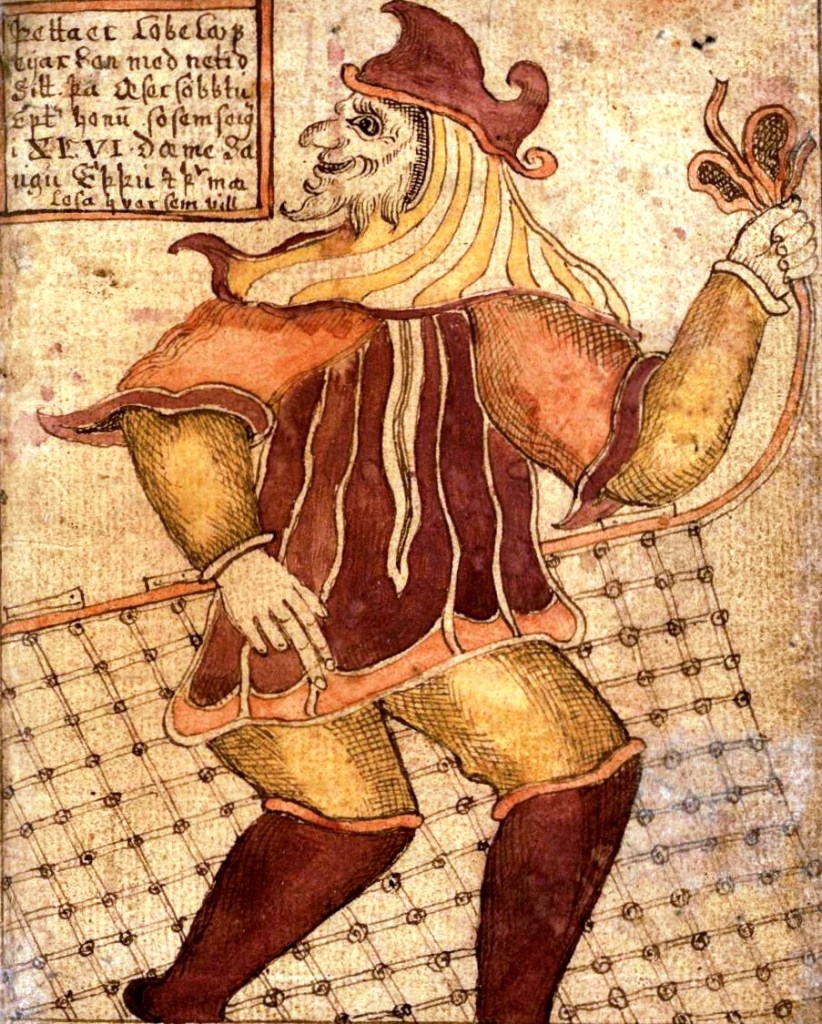
Loki with a fishing net as depicted on an 18th-century Icelandic manuscript
II. Additional Activities
Rituals
Fire Ritual: Burn What Binds You
Use fire symbolically to represent transformation:
Write down a habit, fear, self-limiting belief, or societal norm you wish to let go of.
Light a candle or small fire and burn the paper (safely).
Speak aloud: “In the fire of change, I am freed.”
This act mirrors Loki’s chaotic but necessary role in burning away stagnation.
Candle Meditation: The Dancing Flame
Loki as a flame can represent constant motion and unpredictability.
Light a single candle.
Watch it dance and flicker.
Reflect on what in your life is in motion, unstable, or growing.
Ask: How can I dance with the flame instead of trying to extinguish it?
Create an Archetype Focus
Build a focus to Loki as a symbolic force, not a literal being:
Use objects that evoke mischief, change, fire, serpents, masks, or thresholds.
Include quotes about chaos, transformation, or liberation.
Use it as a focus for meditation, reflection, or gratitude for life’s beautiful messiness.
Recreation
Chaos and Humor Offering
Loki is a bringer of disruption, humor, and irreverence. Honor that by:
Telling jokes or reading satirical stories.
Watching absurd or surreal comedy.
Making playful or ironic offerings (e.g., mismatched socks, rubber chickens, “sacrificial” spicy peppers).
Reflect on how humor helps you cope with or challenge the absurdity of life.
Celebrate Queerness and Rebellion
Many modern devotees honor Loki as a queer, genderfluid, and boundary-breaking figure. Celebrate the freedom to be nonconforming, liminal, or strange.
Attend or support LGBTQ+ events or charities.
Dress or express yourself in a way that challenges binary expectations.
Stargazing and the Dog Star (Sirius)
Since Lokabrenna is an Icelandic name for Sirius, incorporate some skywatching:
Watch the heliacal rising of Sirius, if visible from your location.
Sit under the stars and reflect on endurance through heat and hardship, and how light emerges even from chaotic energy.
Ritual of Reversal
Much like Saturnalia or Fool’s Day, you can set aside a time to reverse norms. It’s about getting uncomfortable in playful ways, and learning from that discomfort:
Let someone else lead if you usually take charge.
Wear something backwards or inside out.
Eat dessert first.
Make a toast to uncertainty.
Personal Growth
Personal Shadow Work
Loki’s mythic arc often reflects the shadow self, the rejected or hidden aspects of who we are. Journal or meditate on:
What parts of myself do I hide or repress?
Where do I fear being “too much”?
What have I been punished or shamed for that might actually be a strength?
Invite these parts into awareness, not to fix them, but to acknowledge and integrate them.
The Bowl That Catches the Poison
In mythology, Sigyn catches the venom dripping onto Loki with a bowl, embodying devotion amid suffering. Place a bowl on your altar or ritual space. Let it represent all you (or others) have carried silently.
Write down emotional burdens: yours or those you’ve witnessed others endure.
Place those slips in the bowl as a symbolic act of witnessing and honoring unseen labor or suffering.
Then reflect: Who holds the bowl in your life? Whose bowl can you help hold?
Grief-Witnessing and Ritual Mourning
Sigyn is a goddess of grief and endurance, and that makes her deeply relevant to atheopagans exploring emotional honesty and mourning. Create a safe space to reflect on personal or collective grief (e.g. climate grief, injustice, personal loss).
Light a candle in Sigyn’s honor while journaling or simply sitting with that grief.
Optionally, pour a small libation of water or wine to the earth as a symbolic offering.
You might recite: “I witness the weight you carry. I honor the love that endures even through sorrow.”
Write a Letter to Your Past or Wounded Self
Sigyn’s energy is gentle witnessing, the part of you that says, “I see what you went through. I’m here.” Write a letter to a younger version of yourself who was struggling, grieving, or feeling alone.
Offer the kind of patience and presence Sigyn represents.
Seal the letter or burn it in the candle flame, letting go or honoring that memory.
Charitable Action
Disruptive Acts of Kindness
Channel Loki’s disruptive nature into positive subversion. This frames chaos as a tool of liberation and compassion:
Do something that “breaks the rules” for a good cause.
Tip outrageously.
Buy coffee for strangers.
Guerrilla-garden an ugly patch of public land.
Post anonymous encouragement in hostile online spaces.
Devotional Acts of Care
Sigyn teaches the sacredness of quiet caregiving, especially the kind that goes unrecognized. Do something caring for someone without drawing attention to yourself: cook a meal, clean a space, write a note of kindness.
Or do something restorative for yourself: rest without guilt, nurture your inner world.
Honor devotion not for applause, but as a sacred act of being human.
Acts of Steadfast Solidarity
Honor Sigyn by standing quietly with those who are hurting, misjudged, or silenced:
Volunteer in care-related roles (mental health, elder care, mutual aid).
Support a friend through a hard time without needing to “fix” anything.
Publicly support marginalized communities while also privately sustaining long-term efforts.








 The Way of Ash and Elm